One file. Three copies.
A climate problem hiding in your cloud.
When you save a file to iCloud, Google Drive and Dropbox, three different companies store the same file in three different data centers — using three times the electricity. Scale that to trillions of files and you get a problem the size of 40 million American homes.
Forget terawatt-hours.
Think houses.
Energy numbers in scientific units don't register. Houses do. Here's what the world's data centers actually consume — today, and six years from now.
What 415 TWh actually looks like


The quiet truth: most of those files are copies.
Here's what happens every time you save a file today — and here's what could happen with SingularVault. Same file. Same access. One-third the energy.
Today: three copies
Every cloud provider keeps its own full copy of your file. Three servers, three sets of electricity, three sets of cooling — for the exact same bytes.
 dog.jpg4.2 MB
With SingularVault
The file is stored once, encrypted. Every provider gets a secure reference that points to it — they can serve it to you, but nobody's making extra copies.
dog.jpg4.2 MBThree simple ideas. One big change.
You don't need to be a technologist to understand this. The whole concept in plain language.
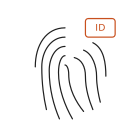
Every file gets a fingerprint
Like yours, every file gets a one-of-a-kind ID. Two identical files always produce the same fingerprint — no matter where they are or who uploaded them.
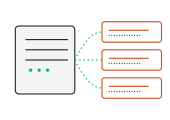
Store once, point to it forever
Instead of every provider keeping the same book, the book sits on one shelf and everyone else keeps a pointer to it. Same access for you — one copy on the planet.
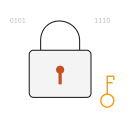
Locked with your key
Your file is encrypted before it leaves your device — locked with a key only you hold. The system can recognise a file without ever seeing what's inside. Same privacy, smarter math.
The line keeps going up.
Data-center electricity use, measured in US homes powered. Every year we wait, the number grows — and so does the share spent on redundant copies.
See the problem in two minutes.
Want the technical brief?
A short overview for engineers and reviewers who want to see how the protocol actually works under the hood.
Read technical overview →Three steps to make this real.
This isn't a product yet. It's a vision that needs brilliant people — and patient capital — to build.
Assemble the team
Bring together specialists in security, large-scale storage and data law. Prove feasibility. Publish openly as we go.
Build the technology
Develop the core protocol and prove it works. Ship a working demo with measurable energy savings on real files, at real scale.
Partner with the clouds
Work with major cloud providers to adopt the system. Share the cost savings. Collaborate with governments on policy.
$690B is going into the cloud this year.
A large share of it pays for duplicates.
Microsoft, Alphabet, Amazon, Meta and Oracle have committed $660–690B of capex in 2026 alone — nearly doubling 2025 levels. SingularVault sits directly in the path of that spend.
Inside a single provider, deduplication already delivers 10–20× reductions. We extend the same idea across providers.
A simple model. Real dollars.
Take a large cloud provider with $125B of 2026 capex — a realistic figure for the biggest hyperscalers. Here's what cross-provider deduplication returns, in real dollars, at different realistic ratios.
How we turn the protocol into revenue.
A low floor for experimentation, a clean per-TB rail for enterprises, and a revenue share that aligns us directly with the climate outcome.
- Provider w/ 100 PB pays $200K/mo
- → saves $15M+ / mo
- Clean, predictable rail
- App · 10M users × 100 calls/mo
- → $1M MRR from one customer
- Bottom-up, viral adoption
- Aligned with climate outcome
- Natural fit for hyperscalers
- Flagship deal structure
1% of the market. A $21B company.
The math only has to work a little for it to work a lot. Here's a conservative path from seed round to an outsized outcome.
This problem needs the right people.
Whether you're an engineer who can help solve it, or an investor who can fund the journey — there's a seat at this table.
Specialists
We're looking for people who've spent time on large-scale storage, security and cloud infrastructure. If you've thought about this problem — let's talk.
Apply as specialist →Investors & partners
The data-center market crosses $1 trillion by 2030. A protocol that cuts global storage by even 20% is a generational opportunity — and a real climate impact.
Investor inquiry →